Computer Control
A control system typically comprises of a computer or microprocessor, a control program which handles data from sensors and sends signals to output devices and an interface box to convert signals between the sensors and the processor.
The role
of computers in control
· Computers can respond very rapidly to change.
· Systems can run 24 hours a day, 365 days a year.
· Control systems can operate in places that humans would find dangerous or awkward.
· Outputs are consistent and error free.
· Computers can process data quickly and machines can operate faster than humans.
Computers are now used to control many types of devices such as:
· air conditioning and central heating systems in large buildings
· security systems and burglar alarms
· manufacturing processes
· traffic lights and pedestrian crossings
The role of sensors in control
Sensors are used to measure physical quantities such as temperature, light, pressure, sound, and humidity. They send signals to the processor. For example:
· A security alarm system may have an infrared sensor which sends a signal when the beam is broken.
· A heat sensitive sensor in the corner of a room may detect the presence of a person.
· Temperature sensors could be used to control the heating in a large building.
· Magnetic sensors are used to detect metal and can be placed in roads to monitor traffic flow.
Other physical quantities that can be transmitted directly to the computer's processor include:
· rainfall/water levels
· radiation level
· pH level
· oxygen level
Feedback cycle
The diagram below shows a control program for maintaining the water level in a fish tank.
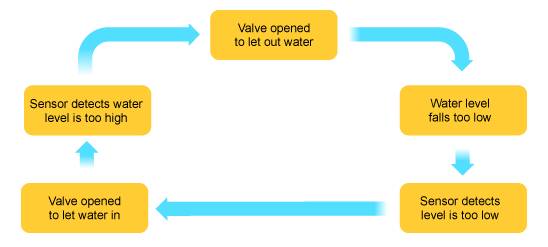
The control program stores the highest and lowest acceptable water levels and what action to take if they're exceeded. The process is continuous and is called a feedback cycle.
Stages of the feedback cycle
· sensor detects water level is too high
· water level falls too low
· sensor detects water level is too low
· valve opened to let water in
· valve opened to let water out
A computer-controlled greenhouse
To get the best plant growing conditions temperature and humidity (moisture in the air) have to be controlled.
The greenhouse therefore has temperature and humidity sensors linked to a computer, and the computer has a control program storing details of the correct temperature and humidity settings. The greenhouse is fitted with a heater, sprinkler and window motor, also linked to the computer.
If the humidity falls below the values stored in the program, the computer activates the sprinklers and closes the windows. If the temperature falls outside the values stored in the program, the heater is activated by the computer.
The system monitors the conditions night and day with immediate response to any changes. To alter the growing conditions the values in the computer program can of course be changed.
Points to Remember
· Computers CANNOT make instant decisions when something unusual happens.
· An interface box is used to convert signals between the sensors and processor.
· Sensors are used to measure physical quantities such as heat, light and sound.
· A magnetic sensor is often used to detect a car approaching a traffic light.
· A temperature sensor would be used in an air conditioning system.
· A humidity sensor would be used in a public swimming pool.
· An ADC (analogue to digital convertor) converts analogue data from the sensors into digital data.
· Central heating and air conditioning control systems often make use of feedback.
· microprocessor: an integrated circuit that contains all or most of the individual elements of a central processing unit (CPU)
· program: a list of instructions written in a programming language
· sensor: an automatic input device that continuously monitors a set of computer controlled parameters, eg a parking sensor detects how close a vehicle is to the nearest object and alerts the driver if the distance falls outside of the specified parameters
· processor: shorthand for central processing unit (CPU).
Question/Answer
A burglar alarm system is
used to detect when a burglar has entered a house. Name sensors
which could be used to detect the burglar’s presence. For each one say how it
is used to do this.
• Sensor Pressure Pad
– detects weight of burglar
• Light/Infra Red Sensor
– detects broken beam
• Contact Sensor
– detects door /window opening
• Temperature Sensor
– detects body heat
• Sound Sensor
– detects any noise made by burglar
Question/Answer
A gardener wants to use a computer to monitor the growing conditions in his greenhouse.
– Name the sensors that he will need.
• Humidity Sensor, Moisture Sensor, Temperature Sensor, pH Sensor and Light Sensor.
– Explain why computers are unable to read the data directly from these sensors.
• Sensors produce analogue data / signal
• Computers work in digital, So computer is unable to understand data generated by the sensors.
Question/Answer
– What device is needed to enable the computer to read the data?
• Analogue to digital converter / ADC will convert analogue data generated by sensor into computer understandable digital data.
– Give two advantages of using a computer to monitor the conditions rather than having it done by humans.
• Computer readings are more accurate / precise
• Readings can be taken more frequently.
• Readings can be taken any time of day or night
• Can produce graphs more quickly
• More reliable
